
Integrating the latest neuropsychobiology and psychology research in the most comprehensive Resilience diagnostic

What is Resilience and why measure it?
Resilience is our ability to positively adapt and bounce back from life's challenges through mental, emotional and behavioural flexibility. Measuring resilience provides a gauge of our capacity to navigate adversity and thrive in an ever-changing world.
The Personal Resilience Indicator (PRI) is a cutting-edge instrument, precision-engineered to guide and accelerate personal development. It is an independently scientifically validated psychometric that integrates the latest insights from neuroscience and psychology in a single assessment. What sets the PRI apart from other instruments is its ability to deliver unparalleled insights into an individual’s current level of emotional resilience by crafting a holistic resilience profile across six domains and twelve drivers.

The latest neuro-psychobiology in a single assessment

Science-Based
The PRI distills more than three decades of neuroscience and psychology research into one integrated assessment. Crafted by a dedicated team of experts, (including neuroscientists, psychologists, executive coaches, therapists, and corporate trainers) the PRI offers a practical and insightful approach to understanding brain health.

Insight-Driven
The PRI provides a holistic overview of an individual's current level of resilience across six domains and twelve drivers. Each driver can be strengthened through targeted, evidence-based exercises and techniques. Our PRI report encourages meaningful, insight-driven conversations, ensuring a deep understanding and genuine commitment to the 'Why,' 'What,' and 'How' of the development journey.

Development-Focused
The PRI offers a tangible measure of progress, functioning as a structured guide to facilitate, expedite, and assess personal growth. Whether you embark on one-on-one coaching journeys, group training, or corporate mental wellbeing programs, the PRI becomes a trusted ally in tracking and elevating the development process.

Independently Validated
The PRI's credibility is bolstered by an independent, blinded analysis by an esteemed psychometric expert. Their findings highlight the PRI's exceptional psychometric properties and superior reliability over other resilience tools. This validation firmly establishes PRI as the trusted choice for enhancing personal resilience and mental wellbeing in various contexts.
The power of the Personal Resilience Indicator
In contrast to conventional resilience assessments that can take hours to put into a meaningful context, the Personal Resilience Indicator (PRI) reveals insights in mere moments.
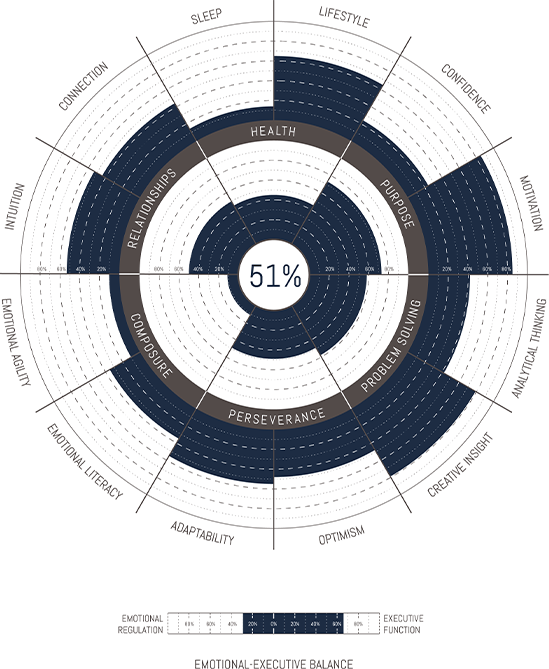
The circular PRI graphic goes beyond a simple score; it provides individuals with valuable background by positioning their score relative to the broader population. This unique feature allows individuals to understand precisely where they stand compared to others, offering insights into how their resilience measures up in real-world terms.
Additionally, the PRI graphic delves deeper, breaking down resilience into 6 domains and 12 drivers. This comprehensive breakdown offers individuals a granular view of their strengths. It also highlights areas for growth within the specific facets of resilience by helping to uncover the bedrock of beliefs and assumptions – the emotional and cognitive patterns that drive our reactions to our internal and external circumstances.
Thus, the Personal Resilience Indicator provides a detailed snapshot of resilience in time, allowing individuals to answer the question: “How are my thoughts, beliefs, and behaviors enabling or limiting my ability to positively respond to life’s challenges and enjoy life to the fullest?”.
Armed with these insights, the Personal Resilience Indicator empowers individuals to take charge of their personal growth journey, providing them with actionable insights to thrive in a dynamic world.
The PRI draws from a wealth of scientific research spanning over 30 years. To stay at the forefront of resilience assessments, we continually adapt the PRI by incorporating the latest insights from psychology, neuroscience, and behavioral sciences.
Rigorous statistical and methodological analyses conducted by an independent psychometric expert and professor of Psychology confirm that The Personal Resilience Indicator is an internally consistent, valid measure of personal resilience with robust psychometric properties, with strong internal reliability, structural validity, and convergent validity.
Learn more about the PRI for

Individuals
Engage with the Personal Resilience Indicator (PRI) to explore and understand your unique resilience profile, recognising areas of strength and pinpointing opportunities for growth. It's more than an assessment; it’s a catalyst for personal transformation, designed to empower you to navigate life’s uncertainties and challenges with greater ease and confidence. Embark on a journey of self-discovery equipped with insights and resources crafted to support your personal development in a dynamic, ever-changing world.

Teams
Unlock collective resilience and leadership development with the PRI. The PRI allow you to tap into and strengthen the inherent resilience of your teams. The PRI shines a light on the resilience spectrum within teams, providing essential insights for focused development efforts. With these insights at hand, leaders like yourself are better equipped to create an environment where each member's resilience is recognised and fostered, building a team that is not only resilient but also agile and prepared tackle any challenge ahead.

Organizations
Leverage the PRI to develop and implement data-driven resilience programs that enhance sustainable performance across your organisation. The PRI provides invaluable data and insights, serving as the cornerstone for creating strategic initiatives to bolster resilience at every level. These empower employers to improve the mental health and wellbeing of the workforce significantly, driving scalable and positive change that yields mutual benefits for both employees and the organisation.